 Math Referee
The exceptional dimension-five group: exact ambient geometry and unresolved subgroup index
Current conclusion: the ambient lattice is reflective; the hypergeometric subgroup's thinness/arithmeticity remains unresolved. The portable bundle preserves the exact certificate and independent verifier.
Stage one succeeds: an eight-wall chamber for the exceptional FMS lattice
This is a new exact computation and accompanying mathematical argument dated 2026-10-19. It concerns family II in dimension five only. It supplies an ambient presentation suitable for a later subgroup-index calculation. It does not decide whether the hypergeometric group is arithmetic or thin, and does not repair the paper's thinness assertion.
The complete norm-two reflection group has a finite-volume chamber with eight facets, ten finite vertices and six ideal vertices. Its chamber stabilizer in the time-cone-preserving integral orthogonal group has order 48. Consequently we obtain
Here O^+ means preserving the chosen time cone, not determinant one.
The full orthogonal group is the direct product of this group with the central
group generated by -I. Projective orthogonal transformations are identified
with their unique time-cone-preserving representatives.
Artifacts and reproduction
- certificate.json: every root at the two processed heights, the eight walls, Gram and reflection matrices, all vertices and ideal links, all 48 chamber symmetries, lattice isometries and original-generator words.
- ambient-presentation.g: a GAP presentation of
projective
O(L)on 11 generators and 62 relations, with the original projective companion generators and their subgroup declared. Loading it performs no coset enumeration or index calculation. - chamber.py: exact Sage discovery/export, using QQ and ZZ.
- verify_certificate.py: independent SymPy verifier; it does not import the Sage discovery code or its polyhedral backend.
- independent-verification.json: check results.
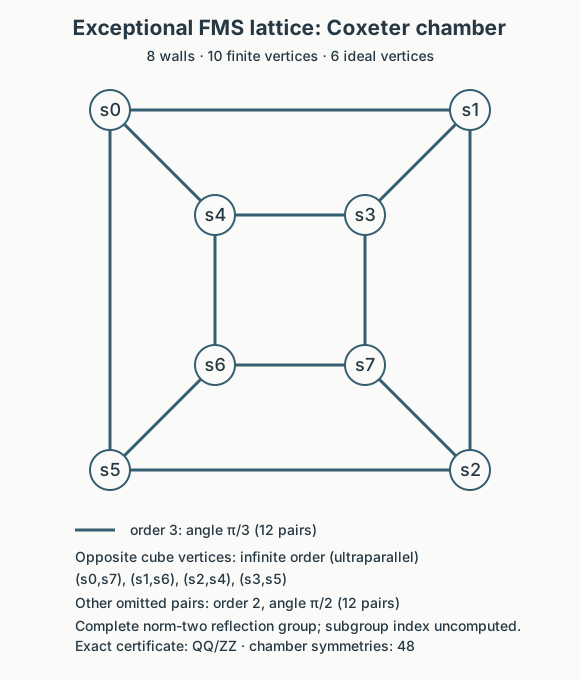
- coxeter-diagram.svg: diagram of all order-three edges, with the four infinite-order pairs listed; other omitted pairs have order two.
- verification.json: artifact hashes and preservation of the earlier audit's frozen inputs.
- sources.json: method references, retrieval details and scope.
On this machine:
env DOT_SAGE=/tmp/math-referee-fms-sage sage -python chamber.py
python3 verify_certificate.py
gap -q -c 'Read("ambient-presentation.g"); Print(Length(GeneratorsOfGroup(FMSAmbient)), "\n"); QUIT;'
Sage 10.7 was already installed in the sage conda environment. No software
installation or paid inference was performed during that stage. This is the subsequently published account.
Coordinates and walls
Use the actual lattice
This is Z times the standard Euclidean realization of D4, not the whole
coordinate lattice Z^5. The preceding audit's unimodular isometry is verified
again and composed with a determinant-two Euclidean D4 basis. Thus no lattice
saturation, rescaling, or change of integral structure is silently introduced.
With the bilinear form of q, choose inequalities <x,r_i> <= 0:
| i | r_i = (t,a,b,c,d) |
|---|---|
| 0 | (0,-1,1,0,0) |
| 1 | (0,0,-1,1,0) |
| 2 | (0,0,0,-1,1) |
| 3 | (0,0,0,-1,-1) |
| 4 | (1,3,2,2,-1) |
| 5 | (1,3,2,2,1) |
| 6 | (1,3,3,0,0) |
| 7 | (1,4,1,1,0) |
All have square two, so the reflections are exactly
s_i(x)=x-<x,r_i>r_i. The matrices preserve the stated integral lattice.
The first four walls impose a >= b >= c >= |d|. At height t=0 there are
exactly 24 roots, the full finite D4 root system. At height t=1 there are
312 roots; their four dominant representatives are precisely rows 4--7.
There is no intervening positive height because t is integral. All four
representatives have pairwise nonpositive inner products.
The full wall Gram matrix is
 2 -1  0  0 -1 -1  0 -3
-1  2 -1 -1  0  0 -3  0
 0 -1  2  0 -3 -1  0 -1
 0 -1  0  2 -1 -3  0 -1
-1  0 -3 -1  2  0 -1  0
-1  0 -1 -3  0  2 -1  0
 0 -3  0  0 -1 -1  2 -1
-3  0 -1 -1  0  0 -1  2
There are 12 orthogonal wall pairs, 12 pairs with angle pi/3, and four
ultraparallel pairs: (0,7), (1,6), (2,4), (3,5). The latter reflection
products have characteristic polynomial (z-1)^3(z^2-7z+1), hence infinite
order. The order-three edges form a cube graph.
Exact finite-volume certificate
In the affine slice t=1, the chamber inequalities are rational linear
inequalities in (a,b,c,d). The first four imply
a >= b >= c >= |d|. Wall 7 implies 4a+b+c <= 16, hence 0 <= a <= 4 and all four
coordinates have absolute value at most four. Thus the affine polytope is
bounded. The point (a,b,c,d)=(4,3,2,1)/10 satisfies every inequality strictly.
Both Sage and the independent verifier enumerate every nonsingular intersection
of four walls and retain those satisfying all inequalities. There are exactly
16 vertices, and every proposed wall supports a three-dimensional facet.
Every vertex has Euclidean squared norm at most 16. Since the squared norm is
convex, the entire affine polytope lies in the closed Klein ball |v|^2<=16.
Ten vertices lie strictly inside; six lie on the sphere.
At each of the six ideal vertices the four active wall normals have a positive-semidefinite Gram matrix of rank three, with a strictly positive null vector. Their Euclidean horospherical links are bounded simplices (affine A3). Thus the cusps have finite volume. The finite vertices have positive-definite active Gram matrices. This is a finite-volume hyperbolic Coxeter polytope, so the classical Coxeter fundamental-polyhedron theorem gives the presentation of the group W generated by its eight wall reflections:
where m=2 for Gram entry zero, m=3 for entry minus one, and no pair
relation is imposed for entry minus three. This classical geometric theorem
is an accepted mathematical input; checking the displayed matrix relations
alone would not establish that the presentation has no missing relations.
Why no higher-height norm-two root is missing
Here is a direct infinite-height argument, beyond the finite enumeration.
It proves W=R2(L) and does not rely on Nikulin's exceptional-lattice table.
Take any norm-two root r=(t,v). Change its sign to make t>=0 and use the
finite D4 Weyl group to make v dominant. Height zero is the finite D4
case. Height one is one of the four already enumerated dominant roots.
Suppose t>=2. If <r,r_i> <= 0 for every wall, then v/t belongs to the
affine chamber. The finite-volume certificate gives |v/t|^2<=16, contradicting
q(r)=2. Thus some wall pairs positively with r. Dominance rules out the
first four, so the wall is s=(1,u) with |u|^2=18.
Reflecting reduces the height to
It remains to exclude a negative height. Cauchy--Schwarz and |v|^2=16t^2+2
give
because (17t+1)^2-(288t^2+36)=t^2+34t-35>0 for integer t>=2.
The reflected root is integral, so t'>=0. Its height strictly decreases.
Reapply the finite Weyl group and repeat. This terminates at height zero or
one. Every norm-two root is therefore W-conjugate, up to sign, to one of the
eight wall roots; conjugation carries its reflection into W. Conversely each
wall reflection belongs to R2(L), proving equality.
The norm-two qualification matters: we have not assumed every integral reflection has a norm-two normal. Additional integral isometries are covered by the chamber stabilizer in the next step.
Full ambient group and companion generators
Every integral time-cone-preserving isometry normalizes R2(L) and permutes
its chambers. Compose it with an element of W to preserve this chamber.
Its remaining action must permute the eight inward-oriented, normalized wall
roots and preserve their Gram matrix.
All 8! permutations were checked independently: precisely 48 preserve that
matrix. Each extends uniquely to a rational linear isometry, and every one
preserves the actual D4 lattice, as verified in its integral basis.
Thus all 48 are realized. Their permutation action is the full cube symmetry
group C2^3 semidirect S3 = W(B3). There are no further chamber symmetries,
and O^+(L)=W semidirect W(B3).
The GAP file uses eight wall involutions and three B3 involutions a,b,c
with (ab)^4=(bc)^3=(ac)^2=1, together with their verified conjugation action
on the eight walls. Its 62 relations comprise 11 involution relations,
24 finite wall-pair relations, three finite-factor pair relations and
24 conjugation relations.
The original polynomials are
The companion matrices A,B,C=A^-1 B are reconstructed independently.
Their Euclidean-coordinate matrices, exact changes of basis, central signs,
wall words and chamber-symmetry words are in the certificate. Matrix
multiplication verifies every word exactly. The time-cone representatives
are -A, B, and -C. GAP declares their projective subgroup as
FMSProjectiveH; this declaration is not an index result.
What is proved, and what remains
Stage one produces a checked ambient chamber, completeness argument and
presentation. The independent verifier checks all rational vertices,
principal minors, complete low-height root sets, all finite-factor
symmetries and original-generator identities. It also checks a known finite
D4 root orbit and rejects an incomplete chamber: dropping wall 7 admits
the spacelike point (1,16/3,0,0,0).
This is exact computation plus a written proof using classical hyperbolic Coxeter theory, not a Lean formalization. The index of the hypergeometric subgroup is uncomputed. A later successful coset enumeration could establish finite index; a resource limit would establish no infinite-index conclusion. No claim about the historical priority of this chamber description is made.
Sources and attribution
The construction follows Vinberg's method, here specialized to norm-two roots and supplemented by the explicit height-descent proof above. Bogachev's two-page description is cached as vinberg-description.pdf. It states the nearest-mirror construction and finite-volume stopping criterion, citing Vinberg 1972 and 1975. The original 1972 article was not newly inspected in this stage. The Coxeter fundamental-polyhedron/presentation theorem is accepted as a classical external input, not claimed to have been formally reproved by the scripts.
Bogachev and Perepechko's VinAl implementation was inspected as a software reference. It was neither installed nor executed: the small norm-two calculation here has a standalone reproducible implementation. Modern software is used for this new investigation; it is not evidence that the original FMS paper supplied this calculation.
Extended stage-two computation
The one-billion-coset portfolio is complete. No run produced a completed coset table for the hypergeometric subgroup. Arithmeticity versus thinness remains unresolved. Overflow and time limits are not infinite-index proofs; temporary cosets are not lower bounds on the actual index.
Which chamber, which group?
The eight-wall finite-volume chamber from stage one belongs to the ambient norm-two reflection group W=R2(L). It proves W has finite covolume. The hypergeometric subgroup H is generated by different elements. Its fundamental domain has not been constructed. Its index in G=O^+(L) is the unanswered question.
The finite quotient gives [G:H]=6[W:W intersection H]. The second factor may be finite or infinite. In addition, both projective companion generators have determinant +1, while each of the eight wall reflections has determinant -1. Thus none of those individual wall reflections belongs to H. This distinction does not prove thinness: orientation-preserving subgroups can have finite index.
Adding the determinant character to the finite quotient gives a definite, modest result: the quotient image of G has order 96, and H's image has order eight. H is contained in an overgroup of index 12. Consequently if its actual projective index is finite, it is a multiple of 12, and it is at least 12 in any case. See orientation-quotient.json and fms_verify_orientation.py.
Large-memory portfolio
All six runs had a 1,000,000,000-coset cap and a nominal 720-second external wall limit, checked at five-second intervals (completion observations can include one polling interval of grace). The unchanged standalone ACE engine was used. Four simplified-presentation runs reserved 5G integer words each; two original-presentation runs reserved 12G words each: 176 GB of table space in total. Address-space caps were 28 GiB and 60 GiB per process. Monitoring retained available memory, peak RSS, CPU observations and per-run progress. The algorithm is sequential within each run, so parallelism was used across different strategies and presentations.
The engine's integer row limit and workspace implementation were inspected. Allocated row capacities stayed below 2^31-1, workspace used its supported 64-bit-addressing M/G suffixes, and no wrap in the recorded row/definition counters was observed. No source patch to the ACE engine was made.
| Run | Outcome | Wall seconds | Peak RSS GiB |
|---|---|---|---|
| simple-default | enumeration_limit | 560.2 | 16.5 |
| simple-hlt | enumeration_limit | 270.1 | 14.9 |
| simple-hard | enumeration_limit | 265.1 | 14.6 |
| simple-felsch | enumeration_limit | 320.1 | 14.7 |
| original-default | wall_time_limit | 725.3 | 45.5 |
| original-hlt | enumeration_limit | 605.2 | 41.0 |
Peak aggregate RSS sampled across this six-run portfolio was 141.1 GiB. Individual run status files retain their final durations. The originally executed supervisor kept updating the displayed age of completed jobs; the report uses the immutable per-run completion records instead. Both the executed snapshot and corrected supervisor are archived. No jobs remain running.
Better exact subgroup descriptions
An ambient conjugation moves the finite-order generator's center into the known chamber, reducing the four-generator presentation's subgroup words from lengths 76/71 to 14/17. Independent rational matrix checks verify the conjugator, original generators, transformed words and unchanged relators. Default/HLT trials at 100 million cosets still overflowed; a ten-million default control trial also overflowed.
A second exact conjugation moves the Cartan involution center to the center of the ambient chamber. It yields an index-six overgroup K=W semidirect (C4 x C2), presented using three generators and eight relators. The target subgroup is simply <s*t,z>. Its relation to the original group is [G:H]=6[K:H_conjugated]. All 24 finite wall-pair relations are covered by the regular finite-factor action; the matrix identities are retained in fms-reduced-overgroup/certificate.json. Default and HLT trials at ten million cosets also overflowed. This presentation is available for further work.
Evidence and reproduction
summary.json records outcomes and limits. portfolio.json retains the periodic monitoring snapshot; each run has ace.input, input.json, ace.log and status.json. verification.json pins the files and preserves the previous trial and stage-one hashes. The initial trial contains the unmodified ACE source archive and build provenance. The conjugations, simplified overgroup and orientation quotient have standalone exact verification scripts. These are computational/written certificates, not Lean formalizations. No paid inference or publication occurred.
No actual-subgroup finite action was completed, so no finite-index certificate is claimed. Should a later enumeration finish, verifying its permutation action alone would still require subgroup-membership or Todd--Coxeter trace evidence before treating its degree as an independently certified exact subgroup index.
Selected downloadable records
Extended trial summary, orientation quotient, and portable certificates with selected ACE inputs. The historical extended README describes more private runtime records than the public selection; the bundle inventory is authoritative for the public files.
Additional supporting archive items are identified in the original report. View the manuscript hashes and repository snapshot.